
Franklin County Active Warrants
No official Franklin County NC active-warrant search portal or active-warrant list was located in the county and sheriff sources reviewed for this build. That means a Franklin County warrant lookup should not begin with third-party wanted-person sites. The Franklin County Sheriff's Office is the local law-enforcement contact point, and the office lists its main number as (919) 496-2186. A person checking personal legal status should use counsel or the proper court contact rather than a tip form, since tip channels are built for reporting information to law enforcement.
Warrants in Franklin County may be issued through magistrate or court process, served by law enforcement, and later tied to a District Court or Superior Court case. North Carolina does not have a separate municipal court layer for town traffic or criminal cases, so town police activity in Louisburg, Franklinton, Bunn, Youngsville, or another municipality still routes into the state court system. For court-linked warrants and orders for arrest, the practical fallback chain is the Sheriff's Office, the NC eCourts Portal, the Franklin County court contact directory, and the Clerk of Superior Court.
The Franklin County Sheriff's Office homepage is the official local starting point for sheriff contact details and current office routing.

That sheriff source supports using official Franklin County contact channels before relying on any outside warrant directory.
Types of Franklin County Warrants
Franklin County warrant records can involve several types of court or law-enforcement process. An arrest warrant authorizes taking a person into custody based on probable cause. A search warrant authorizes a search and seizure. A bench warrant, often called an order for arrest in North Carolina court practice, can follow a missed court date, contempt issue, probation violation, or failure to comply with a court order. Returned warrants may become part of a court file when law enforcement sends the process back to the issuing court.
- Arrest warrant - Judicial process allowing arrest after probable cause is found.
- Search warrant - Judicial process allowing a search of a place, person, or item and seizure of evidence.
- Bench warrant or order for arrest - Court process often tied to missed court, contempt, or noncompliance.
- Fugitive warrant - Process connected to a wanted person from another jurisdiction.
- Civil enforcement process - Arrest-like process may arise from child support, contempt, or other civil court orders.
Returned arrest warrants and returned search warrants are different from active, unserved process. Under N.C.G.S. 132-1.4, arrest and search warrants that have been returned by law-enforcement agencies are court records and may be withheld only when sealed by court order. Active investigative material is more limited, so the public may see the court record after return without getting the full law-enforcement investigation file.
Search Franklin County Warrant Channels
Because Franklin County does not publish an official active-warrant search, the access path depends on the record type. The Sheriff's Office can receive warrant and fugitive tips and can be contacted for law-enforcement routing. The Clerk of Superior Court and NC eCourts Portal are the right channel for case status, returned warrant filings, court dates, and orders that appear in the court case. Magistrates may be involved in initial criminal process and can be reached through the local court directory at (919) 497-4280.
- Search the NC eCourts Portal for the Franklin County case if a case number, party name, or court date is known.
- Call the Clerk of Superior Court at (919) 497-4200 for procedural questions about court records, court dates, and returned process.
- Contact an attorney before trying to confirm or resolve personal active-warrant status.
- Use the Sheriff's Office main number, (919) 496-2186, when the issue is law-enforcement routing rather than court-copy access.
- Use the United for Safety tipline only to provide information about active warrants, fugitives, or criminal activity.
Statewide public systems do not replace this local chain. NC eCourts can show court case information for Franklin County, and the NC Department of Adult Correction covers state custody, probation, and parole records. The state offender search is not an active county warrant database.
Franklin County Warrant Tip Fields
The only warrant-related online form documented in the official Franklin County Sheriff research is the United for Safety tip page. It is not a warrant confirmation tool and should not be used to check whether the person submitting the form has an active warrant. The form is for information about criminal activity, sought-after fugitives, unlawful incidents, and people with active warrants. The tipline number listed by the Sheriff's Office is 919-514-9577.
| Field Label | Type | Required | Notes |
|---|---|---|---|
| Text | Unspecified | Used for tipster contact if provided. | |
| Phone | Text | Unspecified | Phone contact field on the sheriff tip form. |
| Message | Textarea | Unspecified | Tip narrative about the incident, warrant subject, or fugitive information. |
| Date of Occurance | Text or date | Unspecified | The form spelling appears as "Occurance" in the inspected source. |
| Time of Occurance | Text or time | Unspecified | Used to give timing details about the reported event. |
The Franklin County Sheriff's Office send-a-tip page is the source for the tipline and warrant/fugitive tip language.

That source is useful for reporting information, but it does not create a public warrant search result or legal-status confirmation.
What Franklin County Warrant Records Show
No Franklin County active-warrant listing sample was available from an official source, so field claims should stay tied to returned warrants and court files. When a warrant becomes part of a court record, the useful information may be spread across the warrant, the criminal case, the hearing record, and the docket entries. A search result in eCourts may also show case status without showing every document image or law-enforcement detail.
| Field | What It Shows |
|---|---|
| Case number | The court case or record number tied to the returned process. |
| Defendant or suspect | The person named in the court process, subject to redaction or sealing rules. |
| Offense or statute | The alleged offense or legal basis connected to the warrant. |
| Issuing judicial official | The magistrate, judge, or other judicial officer who issued the process if shown. |
| Issue and return dates | When the warrant was issued and when law enforcement returned it to court. |
| Agency and service status | The serving agency and whether the process was served, returned, or otherwise updated. |
| Seal or redaction status | Whether a court order or statute limits public access to the record. |
These fields are record indicators, not proof that a person currently has an active warrant. Court status can change after surrender, arrest, recall, service, bond action, dismissal, or a later hearing.
Resolve a Franklin County Warrant
A person who may have an outstanding Franklin County warrant should avoid treating an online search as legal clearance. The first step is usually to contact counsel, then use the Clerk of Superior Court or court case information to confirm the related case, court date, and status. If counsel advises surrender or a court appearance, coordination may involve the Sheriff's Office, the magistrate process, and the court division handling the case. Bring identification, the case number if known, and any bond or payment information only if counsel confirms it is appropriate.
Important: Speak with a lawyer before arranging surrender, payment, or court action on a possible Franklin County warrant.
After a warrant is served, recalled, or resolved, case information may not update at once. The safer follow-up is to verify the court record through NC eCourts or the Clerk of Superior Court. A law-enforcement or jail custody issue may also connect to Franklin County inmate records if a person is booked into the Detention Complex.
Franklin County Warrant Tips
The Sheriff's Office uses United for Safety language for tips involving criminal activities, individuals with active warrants, sought-after fugitives, and unlawful incidents. The local tipline listed in the research is 919-514-9577. A tip should give useful facts such as names, location, dates, times, vehicle information, and the reason the person may be wanted. It should not be used as a substitute for a court appearance, attorney call, or personal warrant check.
The Franklin County public records request page gives broader county records routing, including directions for records that are not court documents.
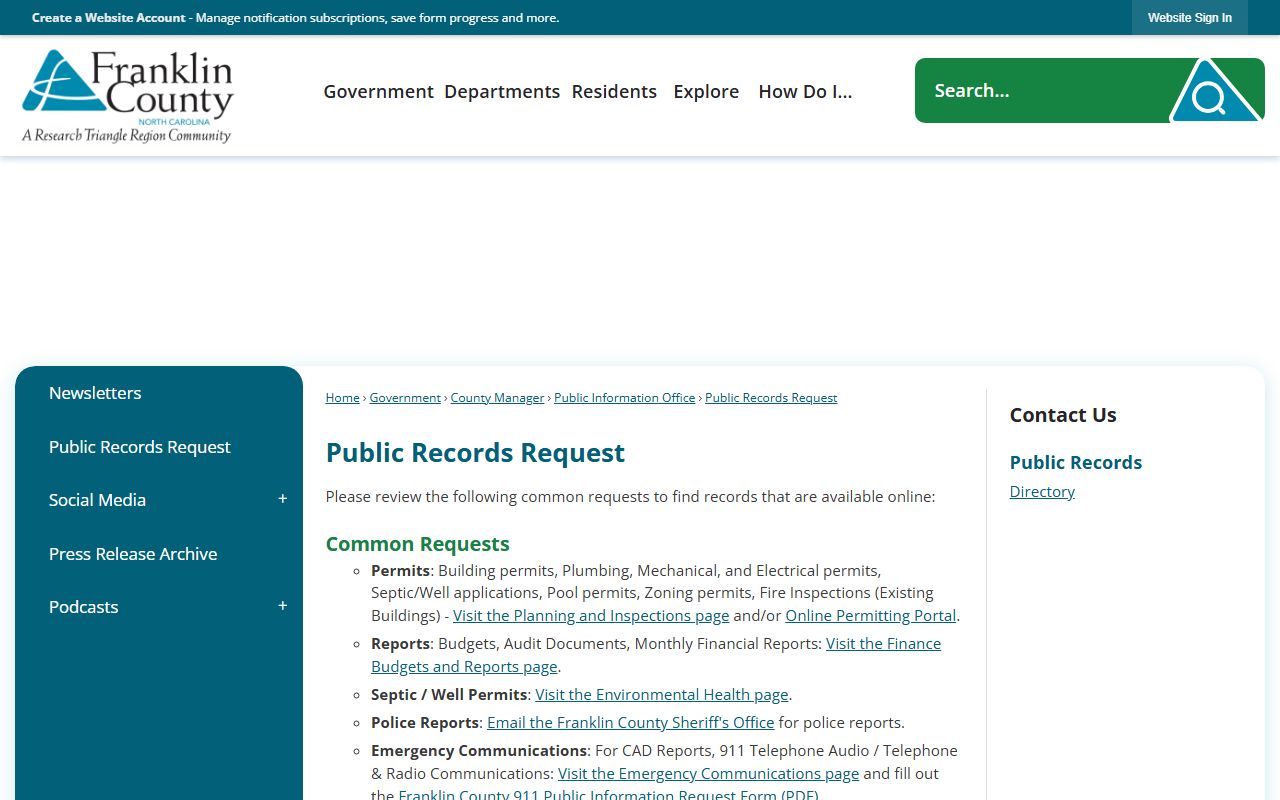
That county routing matters because court documents, police reports, 911 records, and other public records do not all go to the same custodian.
Restricted Franklin County Warrant Records
Not every warrant-related record is public. Investigative records can be withheld under North Carolina law, even when basic arrest or charge information is available. Juvenile records are confidential under N.C.G.S. 7B-3000, and sealed or expunged records are not ordinary public files. Mental health, substance use, and developmental disability records are also restricted by N.C.G.S. 122C-54.
Federal warrants are separate from Franklin County state court records. Federal matters for Franklin County route through the Eastern District of North Carolina and federal law-enforcement channels, not the Franklin County Clerk of Superior Court. When a case has both state and federal activity, check the record source that created the process.
Note: Returned warrants may be public court records, but sealed cases, juvenile matters, and active investigations can limit access.