
How to Search Franklin County Court Records
Franklin County court records are searched first through the NC eCourts Portal. Franklin County went live on eCourts on April 29, 2024, so local users now use Portal for public case information, hearing searches, eligible payments, and judgment search rather than a county-built court database. Portal can be useful for a name search, case-number search, hearing date check, or payment review, but it is not the final source for every need.
For best results, start with a case number when one is known. Name searches use last-name and first-name formats, and wildcard searches require enough characters to keep results usable. Portal also depends on JavaScript, cookies, and periodic CAPTCHA checks. If Portal is unavailable, if the case is not visible, or if a full file copy is needed, the fallback is the Clerk of Superior Court at the Franklin County Courthouse.
- Open the NC eCourts Portal and choose Smart Search for case information.
- Enter a record number or a party name in last, first format.
- Use Advanced Filtering Options and choose Franklin County as the location.
- Check case type, case status, filing dates, hearing entries, and payment eligibility where shown.
- Contact the Clerk of Superior Court for certified copies, older files, and background-check searches.
The Smart Search screen is the main case lookup tool for Franklin County court records. The NC eCourts Portal source shows how court users can narrow Franklin County court records by party, case, and location.
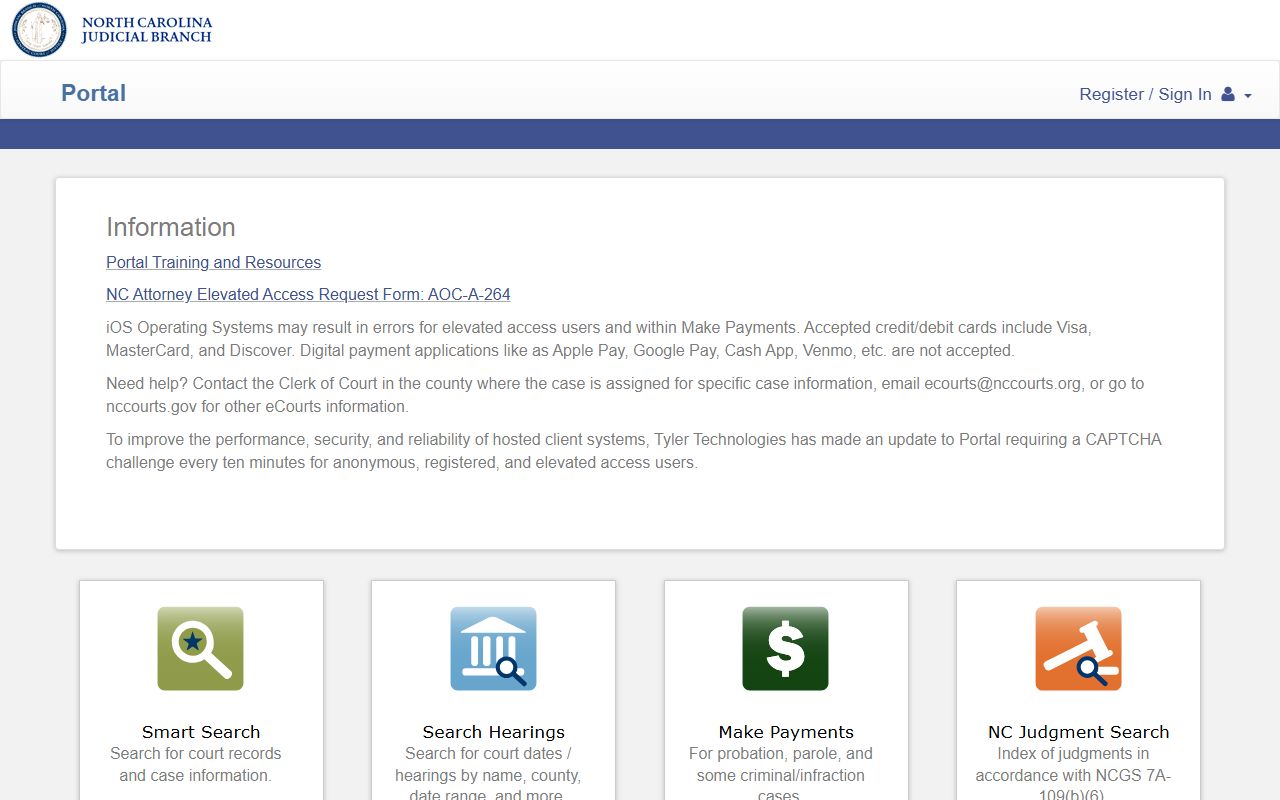
That portal is the online entry point, while the clerk remains the source for official court copies and file questions.
The Franklin County Judicial System
Franklin County does not operate a separate county court system. Local court records are part of the North Carolina General Court of Justice. The statewide structure has an Appellate Division, a Superior Court Division, and a District Court Division. In Franklin County, Superior Court and District Court sit in Louisburg, and both route filings, dockets, copies, estates, and public access questions through the Clerk of Superior Court.
Superior Court handles felony criminal cases, civil cases over $25,000, appeals from District Court in many matters, and contested probate caveats when a will challenge reaches a judge. District Court handles misdemeanors, infractions, traffic citations, small claims, juvenile matters, domestic cases, and magistrate matters. Franklin County is in Prosecutorial District 11, Superior Court District 11, and District Court District 11.
Case flow: Magistrate or District Court filing › District Court or Superior Court › North Carolina Court of Appeals › Supreme Court of North Carolina where review is allowed.
| Court | Jurisdiction | Case Types |
|---|---|---|
| Franklin County Superior Court | General trial court for higher-level matters | Felonies, civil cases over $25,000, appeals, will caveats |
| Franklin County District Court | Local trial court for lower-level and family matters | Misdemeanors, infractions, traffic, juvenile, domestic, small claims |
| Magistrates | Part of the District Court Division | Initial process, warrants, small-claims functions, after-hours judicial duties |
Franklin County Courthouses
The main Franklin County court record counter is at the Franklin County Courthouse in Louisburg. Court users go there for the Clerk of Superior Court, Superior Court, District Court, magistrate contacts, the District Attorney contact point, Guardian ad Litem, custody mediation, community service, and court-record copy questions. The Register of Deeds is nearby in the Hamilton Hobgood Courthouse Annex and handles marriage licenses, marriage certificates, vital records, deeds, maps, and related index searches, not court case files.
Franklin County Courthouse
102 S Main St.
Louisburg, NC 27549
(919) 497-4200
Franklin County Register of Deeds
113 S Main Street
Louisburg, NC 27549
919-496-3500
Franklin County Detention Complex
285 T Kemp Road
Louisburg, NC 27549
(919) 496-2186
The courthouse handicapped entrance is on Nash Street. The Hobgood Annex accessible entrance is on Main Street. Because no official parking-rate page was located, court visitors should allow time for downtown Louisburg parking and check posted limits before a hearing or record request.
Types of Court Records Available in Franklin County
Franklin County court records include civil, criminal, family, traffic, probate, estate, guardianship, judgment, and docket material. The type of record matters because each file has a different access path. A traffic citation may be payable through Portal, while a certified divorce judgment must come from the clerk in the county where the divorce was granted. An estate file is handled by the Clerk of Superior Court acting in a probate role.
Portal can show case information, hearing data, payment eligibility, and some judgment search information. Complete copies come from the clerk. Law-enforcement reports, jail information, and active warrant questions may start with the Sheriff's Office, but returned warrants and charging documents tied to a case become court records unless sealed.
- Criminal records cover charges, pleas, hearings, disposition, judgment, sentence, and probation terms where public.
- Civil records include complaints, summonses, motions, orders, judgments, liens, and execution papers.
- Family and divorce records may include divorce judgments, custody filings, support matters, and restricted minor or address information.
- Probate records include wills, letters, inventories, accountings, guardianship files, and special proceedings.
- Traffic records show citation case data, court dates, dispositions, costs, and payment status when available.
What Franklin County Court Records Show
A Franklin County court record should be read as a case file, not just a name result. The key fields show the court location, parties, case type, filing date, hearings, docket entries, disposition, and any judgment or sentence. Criminal court records may show charge data and later outcome data, but a charge is not the same thing as a conviction. Civil court records may show claims, motions, orders, and money judgments.
| Field | What It Shows |
|---|---|
| Case Number | Unique court record number used for Portal, clerk, hearing, and copy requests. |
| Filing Date | Date range that can narrow Smart Search results and show when the case began. |
| Parties | Names of plaintiffs, defendants, petitioners, respondents, the State, attorneys, or estate parties. |
| Charges / Cause | Offense, citation, claim, petition, or estate matter tied to the case type. |
| Disposition | Outcome such as dismissed, guilty, not guilty, judgment entered, settled, or closed. |
| Sentence / Judgment | Penalty, probation, fine, restitution, civil money judgment, order, or estate ruling where public. |
Public Access Laws for Franklin County Court Records
North Carolina law gives broad access to public records, but court records, law-enforcement records, juvenile files, mental-health material, and expunged cases follow separate rules. For Franklin County court records, the most useful statute is the clerk recordkeeping law, because it says clerks keep the records, files, dockets, and indexes prescribed by court rules and that those records are open during regular office hours unless the law says otherwise.
Key Statutes:
N.C.G.S. 7A-109 requires clerks to keep court records and makes them open unless another law restricts access.
N.C.G.S. 132-6 requires public-record inspection and copies at reasonable times after lawful fees are paid.
N.C.G.S. 132-1.4 restricts investigative records but preserves public access to basic arrest data and returned warrants unless sealed.
Records That Are Restricted or Confidential
Not every Franklin County court record is open through Portal or at the public counter. Juvenile records are confidential except for authorized people and court orders. Adoption records are not treated like ordinary civil files. Mental health, developmental disability, and substance abuse records have statutory confidentiality limits. Expunged and sealed criminal matters are removed from ordinary public access when the court order and agency processing are complete.
Public case information may also be redacted for Social Security numbers, financial account numbers, minor names, protected addresses, medical details, and sealed exhibits. A person who needs access to a restricted file must use the legal process for that record type through the clerk or court rather than treating Portal absence as proof that no case exists.
Specialty Courts in Franklin County
No official Franklin County adult recovery court, DWI court, mental health court, family treatment court, veterans treatment court, or juvenile treatment court page was found in the researched sources. The North Carolina Judicial Branch links statewide recovery court information, but local referral details were not published for Franklin County. Defendants and families should ask defense counsel, the District Attorney, probation, or the Clerk of Superior Court whether a District 11 recovery-court referral option exists for the case type at issue.
A statewide program description does not prove that a Franklin County docket has a specialty-court track. If a case is accepted into a treatment or recovery program, the court record may still remain under the same criminal, juvenile, or family case number, with eligibility and program status handled through court orders and supervision records.
Franklin County Sheriff and Jail
The Franklin County Sheriff's Office is led by Sheriff Kevin White and is separate from the courthouse record counter. The Sheriff's Office address is 285 T Kemp Road in Louisburg, and the main office number is (919) 496-2186. The Detention Complex page says the facility has capacity for 176 local, state, and federal inmates and uses video visitation, Pay Tel accounts, and JailATM deposits.
No official Franklin County NC online jail roster was located in the research. Custody questions therefore start with the Detention Complex or counsel, not a public county roster. The jail page, Pay Tel, and JailATM help with custody support tasks, while full case status, charges filed in court, and hearings route through Portal and the clerk. The Franklin County inmate records page covers that split in more detail.
Marriage, Divorce, and Clerk of Superior Court Probate
Marriage records and divorce records split between two Franklin County offices. Marriage licenses and marriage certificates are Register of Deeds records at the Hamilton Hobgood Courthouse Annex. Divorce judgments are court records held by the Clerk of Superior Court in the county where the divorce was granted, and NC Vital Records keeps divorce certificates from 1958 forward. Estate and guardianship files are handled by the Clerk of Superior Court because North Carolina clerks act as probate judges for most estate matters.
The Register of Deeds has marriage certificates dating back to 1869 and a marriage bond book with information dating to 1779. Marriage applicants must appear in person, meet age and ID rules, and pay the county license fee. Estate users should start with the clerk before bringing an original will, death certificate, or estate forms to the courthouse.
- Testator
- A person who made a will.
- Executor
- A person named to manage an estate after appointment by the clerk.
- Caveat
- A formal North Carolina challenge to the validity of a will.
Franklin County Court Records Fees
The research located several Franklin County fee details for records adjacent to court access. Court users should confirm current clerk court costs before mailing payment because no Franklin-specific court-copy fee table was found in the local court pages inspected. The county public-record fee schedule states that copy or production fees may reflect actual cost for extensive assistance. Register of Deeds fees are separate from court fees and apply to marriage, land, and vital records.
| Item | Amount |
|---|---|
| Marriage license issuance | $60 |
| Certified marriage certificate | $10 |
| Certified vital record copy | $10 |
| Register of Deeds maps / plats | $21 per page |
| General county public-record production | Actual cost where allowed by fee schedule |
How to Interpret Franklin County Court Records
Common court-record terms can change the meaning of a Franklin County search result. A charge is an allegation filed through a citation, warrant, criminal summons, indictment, or other process. A conviction is a guilty plea or finding of guilt. A disposition is the outcome of a charge or case. A docket is the chronological list of filings, hearings, orders, and case events. A judgment is an enforceable court decision and may be criminal, civil, traffic, or estate-related depending on the file.
Portal results should be checked against the full docket and official clerk copy before being used for a serious purpose. A case may show charges that were later dismissed, reduced, amended, or expunged. A hearing result may not appear as quickly as a courtroom event happens. For background checks, the Judicial Branch directs users to the county clerk's office rather than relying only on Portal.
Accuracy and Record Limitations
Franklin County online court records can lag behind courtroom action, clerk processing, and agency updates. Portal is a public access tool, but it does not replace certified copies, clerk file review, or attorney advice. The Register of Deeds online index also warns that online records are informational and that official records remain in the office. Similar caution applies when a search involves sealed files, juvenile matters, custody data, jail status, warrants, or pending criminal charges.
Note: Confirm urgent court dates, warrant concerns, custody status, and certified-copy needs with the official office that keeps the record.
History of Franklin County Courts
Franklin County was formed in 1779 from the southern half of abolished Bute County and was named for Benjamin Franklin. Louisburg is the county seat, and the local record system reflects both old county records and the modern statewide court structure. The Register of Deeds reports real-estate records dating to 1776, marriage certificates dating to 1869, and a bond book with marriage information back to 1779.
The most important recent change for Franklin County court records was the April 29, 2024 eCourts rollout. Franklin joined other Track 4 counties in moving to Portal, File & Serve, and Enterprise Justice/Odyssey. That explains why current Franklin County case searching often starts online, while older advice about paper-only lookup may be incomplete.
Frequently Asked Questions
Where do Franklin County court records start?
Most public case searches start in the NC eCourts Portal. Certified copies, older files, background-check searches, divorce judgments, estates, and file questions go to the Franklin County Clerk of Superior Court.
Does Franklin County have municipal courts?
No separate municipal court system was found in the official court research. Town police may issue citations or make arrests, but the court case routes through North Carolina District Court or Superior Court.
Are marriage records court records?
No. Franklin County marriage licenses and marriage certificates are handled by the Register of Deeds. Divorce judgments are court records, and divorce certificates may also be available through NC Vital Records.
Is there an official Franklin County warrant search?
No official online active-warrant lookup was located. Returned warrants tied to a case may be court records unless sealed, while active warrant concerns should be handled through counsel, the court, or the Sheriff's Office.